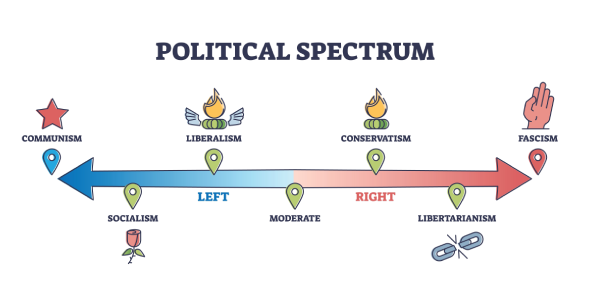
Every morning, I start my day by reading the news. In 2026, this feels like an exercise in masochism. It seems every time I refresh the front page on reddit or twitter, I’m bombarded with a new wave of breaking news. Accompanying each story is a seemingly endless page of comments from ordinary people like me agreeing, disagreeing, or simply decrying “fake news.” Despite this constant stream of information, it feels harder than ever to stay on top of the world’s current events. Put your phone down for a second and you’re completely out of the loop on the current trend of the hour. This flood of information has made it exceedingly difficult to separate the forest from the trees, and to form any sort of measured opinion about the goings on of our world. Whether this is an intentional tactic or simply a byproduct of the information age is unclear. What is clear is the marked effect this whiplash of information has had on the political positioning of the Democrats and Republicans.
Take for example the shooting of Alex Peretti by ICE agents in Minnesota. In the wake of the shooting, Democrats were advocating for the victim’s Second Amendment rights while Republicans were defending the necessity of ICE’s mission. It was odd to me that the Democrats, who have long favored limiting access to firearms, were quick to allege violations of the second amendment. Equally odd was the Republican’s eagerness to defend ICE, a federal government agency with seemingly limitless authority to enforce the mandates of the federal government. On one hand, I understand each party’s knee-jerk reactions to the incident. In the modern age of instant information, it has become necessary to respond immediately. People are accustomed to receiving answers now, and any lack of response would be viewed as weakness or, even worse, culpability. However, with so little time to formulate a response, political figureheads are often forced to resort to the most expedient, logical response at the expense of overarching political values. Politicians no longer have the leeway to craft a position that balances the current desires of their constituents with the longstanding values of their party.
The information age has allowed the common person to receive raw information at a rate nearly equivalent to those in power. This has resulted in a system where politicians act as responders rather than providers. Not so long ago, information could be filtered and fed to the masses in a manner that imbued it with the political ideologies of the provider. There was time to think about how a story could fit into the longstanding traditions of the party. Today, there is no time for strategizing. People want answers and they want them yesterday. This system is not conducive to long-term narrative building. Often the most immediate response does not directly align with historical party precedent, or even the precedent set only a few years prior.
Further, this constant stream of information and response has left no time to marinate on anything for longer than a few days. There is always something new and the immediate past is forgotten quickly. Just over a year ago, Trump was campaigning on the promise of no new wars. Today, we are at war with Iran. Despite this blatant contradiction, there is seemingly little outrage on the side of the Republican party for being outright lied to. The constant bombardment of information has conditioned them to seek answers now. It seems that so long as they receive any form of rationalization in the moment, they are content to simply accept the situation and avoid thinking back to the promises made just a year ago.
The one tenant I thought the Republican party could never break was their rejection of communism and the promotion of the free market. This has long been the lifeblood of the Republicans, their north star. However, even this appears to be changing. Just last year, the Trump administration purchased 8.9 billion dollars worth of Intel common shares, making the US government the single largest shareholder of Intel. Government control of corporations is one of the signature features of a communist state. The Trump administration also imposed tariffs on countries across the globe, hindering the open market and creating an artificial strain on free trade. The recent dispute with Anthropic also has a communist stench, the dispute arising out of the right to surveil the populace. The result of this dispute was the labeling of Anthropic as a supply chain risk, an unprecedented move to hinder the value of a domestic corporation. These actions stand in stark contrast to the Republican party of yesteryear.
Politics are no longer based on strong pillars of political ideology. Rather, politics have become about providing immediate gratification. Party affiliation is no longer based in philosophy, but raw tribalism. It’s similar to rooting for a baseball team. If you are a kid growing up in San Francisco, you will likely become a Giants fan because they are your hometown team. You learn to love the Giants, and that winning team from your youth. They become your team, part of your personality. In 20 years, the team will be completely different, with a whole new cast of players and a whole new style of playing the game. You may not even live in San Francisco anymore. However, this does not matter because it’s still your team, the same team you have always rooted for. Such is the nature of the current political system. Maybe when you first registered as a Republican you wanted limited government and a broad interpretation of the right to bear arms. You may still want these things. But, at the end of the day, you root for your team first. The players may have changed and their approach to the game may have changed too, but you still root for them out of habit. So long as they are putting up “wins” in the moment, there’s no need to question your allegiance to your team.
The information age has made it too difficult to form a coherent ideology. It’s much easier to simply agree with your team than think about something critically. Think too long about something, and you’ve already missed the next big thing. So long as the immediate response makes sense there’s no need to question anything. The result of this thinking has been a dramatic ideological shift in the two primary parties in America. Or rather than a shift, a deterioration of ideology. It is more important to put up wins in the present than to analyze the cohesion of the past or plan for the future. Maybe it’s time to put the phone down and think for a second about what is truly important to us. But maybe that’s asking too much. In the time it took to read this article you’ve probably already missed the next big thing.
Leave a Reply